Colostrum and Acne: Why Some People Report Breakouts
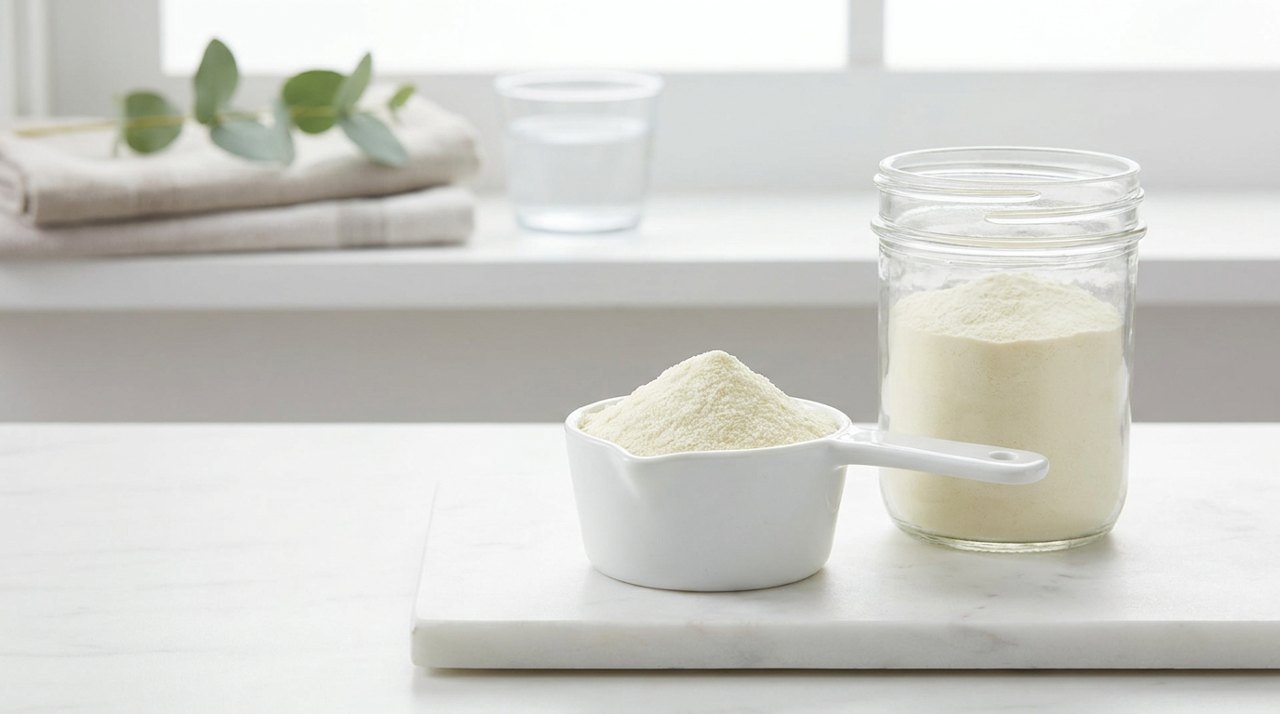
Bovine colostrum is usually marketed for gut and immune support, so it can be surprising when a few weeks of daily use is followed by new spots along the jawline or chin. The evidence linking colostrum itself to acne is thin. However, a plausible explanation exists, built on what we know about dairy, growth factors and hormones. This article covers what is known and what is only guessed, and offers practical ways to work out whether colostrum is really the cause.
- No controlled trial has directly tested whether colostrum supplements cause acne. Reports so far are anecdotal.
- Observational studies suggest a modest link between dairy intake, especially skim milk, and acne. Colostrum is a concentrated dairy product.
- Colostrum contains IGF-1 and other growth factors at much higher levels than ordinary milk. How much IGF-1 reaches the bloodstream after an oral dose is still debated.
- A typical 10 g serving supplies only about 35–40 kcal and 6–8 g of protein. A breakout is more likely to come from a hormonal or individual-sensitivity mechanism than from the calories.
- Lowering the dose, choosing the product carefully and doing a structured 4–6 week break can help you tell whether colostrum is the cause or a coincidence.
What makes colostrum different from regular milk
Colostrum is the first milk a cow produces in the 24–72 hours after calving (see what colostrum is for the full background). Compared with mature milk, it is much richer in immunoglobulins, growth factors and bioactive proteins. Commercial powders are usually standardised to roughly 15–40% IgG by weight, while mature milk contains well under 1 g of IgG per litre.
Growth factors matter most for the acne question. Insulin-like growth factor 1 (IGF-1) is many times more concentrated in early colostrum than in mature milk. Published estimates differ a lot by milking, breed and processing, but first-milking colostrum is often reported in the hundreds of micrograms per litre, compared with single-digit values for retail milk. Colostrum also contains IGF-2, TGF-β and smaller amounts of hormones such as insulin.
| Component (approx.) | Mature cow's milk | Bovine colostrum powder | Possible relevance to skin |
|---|---|---|---|
| IgG | <1 g/L (liquid) | 15–40% of powder weight | Immune-related; no known acne link |
| IGF-1 | Low (single-digit µg/L) | Substantially higher; varies by milking | IGF-1 stimulates sebaceous glands |
| Lactose | ~4.8% (liquid) | Often ~5–20% of powder, product-dependent | Mainly digestive tolerance |
| Energy per 10 g serving | n/a | ~35–40 kcal | Negligible for most diets |
| Protein per 10 g serving | n/a | ~6–8 g | Insulinotropic milk proteins |
The dairy–acne connection: what the research suggests
The idea that dairy can worsen acne is not new, and the evidence is mostly observational. In a retrospective analysis of more than 47,000 women from the Nurses' Health Study II, Adebamowo and colleagues reported that higher recalled high-school milk intake was associated with a history of severe teenage acne. The association was strongest for skim milk. A 2018 meta-analysis by Juhl and colleagues pooled data from more than 78,000 children, adolescents and young adults. It found that any dairy, milk, low-fat milk and skim milk were each associated with higher odds of acne. Cheese and yoghurt did not show a clear association.
These studies have real limits. Most used recall questionnaires, acne is hard to measure consistently, and associations do not prove causation. They are still the main reason dermatologists sometimes ask patients about dairy intake.
Why IGF-1 is the leading hypothesis
Sebaceous glands respond to IGF-1, which promotes sebum production and keratinocyte proliferation and interacts with androgen signalling. Cappel, Mauger and Thiboutot found that serum IGF-1 levels correlated with acne lesion counts in adult women. Melnik has argued that milk proteins are "insulinotropic". In his model, they raise insulin and IGF-1 signalling, which in turn activates pathways (including mTORC1) that may promote acne. This framework is plausible and widely cited, but parts of it remain theoretical.
Does oral colostrum raise blood IGF-1?
This is the weak link in the explanation. IGF-1 is a peptide, and much of it is expected to be broken down during digestion. Results from human supplementation studies are mixed. An early study in athletes (Mero et al., 1997) reported a rise in serum IGF-1 during colostrum supplementation, while several later trials found no meaningful change. Even if colostrum's own IGF-1 is mostly digested, its milk proteins might still influence insulin and the body's own IGF-1 production, as other dairy proteins appear to do. Nobody has shown directly whether typical colostrum doses do this enough to affect skin.
Shopping for colostrum? Our current best-value pick is BIOMIXA grass-fed colostrum powder on Amazon.
Other reasons someone might break out
When a breakout follows a new supplement, the supplement gets the blame, but other explanations are worth ruling out:
- Timing coincidence. Acne naturally fluctuates with menstrual cycles, stress, season and sleep. Starting anything new during a flare can create a false link.
- Added ingredients. Flavoured powders may contain sweeteners, whey or milk powder fillers, or other actives. Some "stacks" include biotin or iodine-rich ingredients, which have been anecdotally linked to breakouts.
- Combined dairy load. Colostrum taken alongside whey shakes, milk-based coffee and other dairy adds to total dairy-protein intake.
- Other supplement changes. Many people start colostrum while also beginning a training block, creatine, protein powder or a new diet.
- Topical contact. Rarely, powder residue around the mouth or on hands may irritate skin in sensitive people.
Practical steps if you suspect colostrum
Because the evidence is limited, a careful self-experiment is often more useful than general rules. The approach below is simple and does not require stopping everything at once.
- Log a baseline. Note your dose, brand, other supplements, dairy intake and a rough lesion count or photo every few days.
- Reduce the dose first. If you take 20 g/day, try 5–10 g/day for 3–4 weeks. Many studies have used doses from about 10 g up to 60 g daily, but you do not need the high end for general use. Our dosage and safety guide covers typical ranges.
- Remove other dairy proteins temporarily. Pausing whey or skim milk can show whether total dairy load is the issue.
- Pause completely for 4–6 weeks. Skin turnover and acne cycles are slow, and a few days is not enough to judge.
- Reintroduce at a low dose. If breakouts return reliably after reintroduction, colostrum, or that particular product, is a reasonable suspect.
- See a dermatologist for persistent, painful or scarring acne. Effective treatments exist, and supplement changes alone are unlikely to be enough.
Product choices that may matter
Products differ widely, and some details may matter to people with acne-prone skin. When choosing a colostrum product, check the full ingredient list for added whey, sugars or other actives, and look for a stated IgG percentage and third-party testing. Unflavoured, single-ingredient products make the self-experiment above much cleaner. Capsules make it easier to control a small, consistent dose, and they also avoid powder contact around the mouth. Our powder vs capsules comparison covers the trade-offs.
| Strategy | Typical approach | Pros | Cons |
|---|---|---|---|
| Lower dose | 5–10 g/day instead of 20 g+ | Keeps some use; easy to try | May not resolve a true sensitivity |
| Switch to capsules | e.g. 2–4 × 500 mg capsules | Precise small doses; no powder residue | Much lower total intake; higher cost per gram |
| Single-ingredient product | Unflavoured, no added whey | Removes confounding ingredients | Less palatable for some |
| Full 4–6 week pause | Stop, then reintroduce | Clearest answer for you personally | Takes time; acne fluctuates anyway |
| Reduce other dairy | Pause whey, skim milk | Addresses total dairy load | Requires broader diet change |
Putting the evidence in perspective
Most people who take colostrum do not report skin problems, and clinical trials have generally described colostrum as well tolerated. Acne has not featured as a notable adverse event in those trials. Those trials were not designed to look for acne, though, and many enrolled adult athletes rather than acne-prone teenagers or young adults. The most honest summary is that a link is biologically plausible and some individuals may be sensitive, but the size and frequency of any effect are unknown. For a broader overview of what colostrum may and may not do, see our benefits summary.
FAQ
Does colostrum cause acne in everyone?
No. Most users do not report breakouts, and clinical trials have not flagged acne as a common side effect. Some people seem to be more sensitive to dairy in general, and they may notice changes. Since no controlled study has tested colostrum and acne directly, nobody knows how common this sensitivity is.
How long after starting colostrum might breakouts appear?
Anecdotal reports usually describe changes within two to six weeks, which is consistent with how slowly acne lesions develop. Because acne also changes with hormones, stress and season, a single flare during that window does not prove cause. A structured pause and reintroduction gives a much more reliable answer.
Is the IGF-1 in colostrum absorbed into the blood?
It is uncertain. IGF-1 is a protein and is expected to be largely broken down during digestion. Human studies disagree: one early trial reported increased serum IGF-1, while others found no significant change. Milk proteins may also affect the body's own insulin and IGF-1 signalling indirectly, but this has not been confirmed for colostrum doses.
Should I stop colostrum if I get acne?
If breakouts are mild, try a lower dose or a single-ingredient product first, and track your skin. If acne is moderate, persistent, painful or scarring, pausing colostrum is reasonable, and you should see a dermatologist. Supplement adjustments do not replace proper acne care.
Sources
- Adebamowo CA, Spiegelman D, Danby FW, et al. High school dietary dairy intake and teenage acne. Journal of the American Academy of Dermatology. 2005;52(2):207–214.
- Juhl CR, Bergholdt HKM, Miller IM, et al. Dairy intake and acne vulgaris: a systematic review and meta-analysis of 78,529 children, adolescents, and young adults. Nutrients. 2018;10(8):1049.
- Cappel M, Mauger D, Thiboutot D. Correlation between serum levels of insulin-like growth factor 1, dehydroepiandrosterone sulfate, and dihydrotestosterone and acne lesion counts in adult women. Archives of Dermatology. 2005;141(3):333–338.
- Melnik BC. Evidence for acne-promoting effects of milk and other insulinotropic dairy products. Nestlé Nutrition Workshop Series: Pediatric Program. 2011;67:131–145.
- Mero A, Miikkulainen H, Riski J, et al. Effects of bovine colostrum supplementation on serum IGF-I, IgG, hormone, and saliva IgA during training. Journal of Applied Physiology. 1997;83(4):1144–1151.
BIOMIXA Bluegrass Colostrum
A grass-fed, unflavored colostrum powder that balances quality and price well — our pick for the best bang for your buck. Check the current price and reviews on Amazon.
Disclosure: BIOMIXA is our own brand — this site is run by the makers of BIOMIXA colostrum. We also earn a commission on Amazon purchases. Full disclosure.